Four ways a PLM can help you capture today's consumer
The rise of digital technology and a generation of connected consumers is changing the fashion retail landscape at breakneck speed, and leaving a string of casualties in its wake.

Surviving Retail's Digital Disruption: How Agile Brands and Next-Gen PLM Are Reshaping the Industry
In 2018 alone, 16 major US retailers declared bankruptcy among them, Sears, Nine West and The Bon-Ton stores with many citing a drop in traffic to physical stores as one of the reasons behind their financial woes. Their demise is symptomatic of a seismic industry shakeup that has established brands falling by the wayside and retail stores shuttering their doors in record numbers, turning bustling shopping malls into desolate ghost towns.
But as with any big disruption, what spells catastrophe for some represents opportunity for others. Online boutiques, pop-up stores, augmented reality retail experiences and subscription boxes have swooped in to pick up the slack, and agile, direct-to-consumer (D2C) fashion brands like Everlane, Bonobos and Allbirds are using innovative online-first strategies to garner loyal followings of customers, while their big-name competitors are watching their sales dwindle at alarming rates.
All bets are off in this new Wild West, where being quick on the draw counts for more than brand size or heritage. The companies most likely to come out on top are the ones who figure out how to turn digital disruption to their advantage, instead of falling victim to it.
Why next-generation PLM matters
Faced with this challenge, smart merchandisers are taking advantage of new technology solutions like the PLM (Product Lifecycle Management) platform to speed up and streamline their supply chain, as well as plan and produce styles that are perfectly targeted to the customers they want to reach.
Originally conceived to connect design and product development teams, next-generation PLMs now bring everybody from suppliers, marketers, sales teams, e-commerce and retail into the loop, centralizing and consolidating data from across the supply chain on one cloud-based platform.
The result is a faster, more flexible process that can keep pace with the digital marketplace and ensure a seamless omnichannel experience.
Four ways innovative merchandisers capture today's consumer
Not convinced? Here are four ways that innovative merchandisers are capturing today’s consumer and how next-generation PLMs are helping them do it.
1. Pulling from different data sources to glean consumer insights
Trying to get into consumers’ heads is nothing new but today’s abundance of technology now lets merchandisers delve deeper than just crunching last year’s sales numbers.
Savvy merchandisers know that customer engagement data, website traffic, abandoned baskets, social media activity and even in-store behaviour are a goldmine of information that can be combined with real-time sales data to provide valuable insight into customer buying preferences and hone merchandising strategies.
Next-generation PLMs have been designed to aggregate all this structured and unstructured data in one place, making it easier to glean consumer insights without having to wrangle data manually from a million different sources.
The result is more accurate trend forecasting and a deeper understanding of what motivates customers to buy.
2. Using data analytics to plan and develop new collections
Aggregating data is only the first step. Smart merchandisers are taking that data and using it early on in their planning process to develop and market collections that tap into the current zeitgeist.
According to research from McKinsey and Women’s Wear Daily, “top performers use data analytics when developing concepts and planning lines” while “underperforming companies tap data much later in the process, only after they have developed the product.”
But for data to be used effectively in the collection development process, it needs to be easily exploitable, so that companies can analyze and act on it quickly, before market mood shifts.
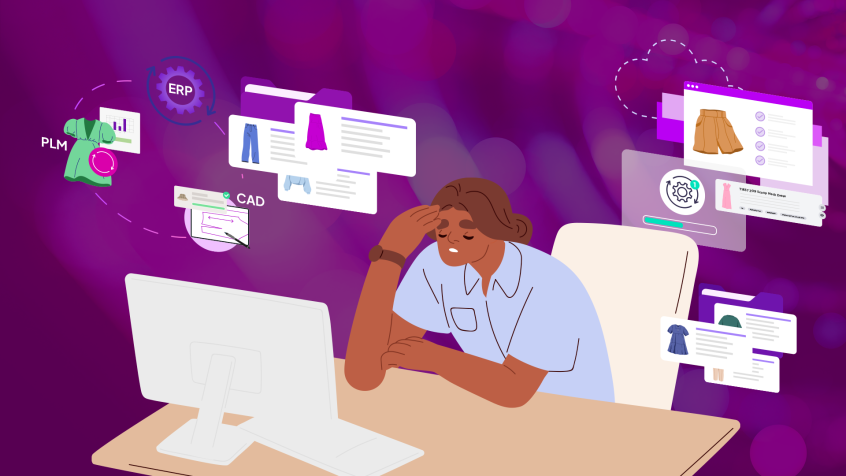
Today's best fashion PLMs integrate seamlessly with ERP, CRM, WMS, DAM and PIM systems across the supply chain. They can pull data quickly from a variety of sources to generate sophisticated reports combining everything from supplier data and last week’s sales to next week’s weather forecast.
This enables merchandisers to create on-point products aligned with current consumer trends.
3. Delivering product to market in 6-8 weeks
Designing a perfect product that speaks to the current mood won’t get you very far if it gets to stores two months too late.
Speeding up time to market is a priority for merchandisers in today’s digital environment, where today’s top trend can become yesterday’s hashtag in the blink of a tweet.
In the study cited earlier, McKinsey found that today’s best-performing companies are the ones able to get product to market in weeks, not months.
By facilitating teamwork and eliminating redundant tasks, a PLM removes inefficiencies that slow collection development down. Information is centralized in one place, creating a single source of truth that everyone can access and modify in real time.
This reduces misunderstandings, minimizes errors and provides merchandisers with an end-to-end view of the development process, helping them identify delays before they occur.
4. Cultivating an agile supply chain that can change gears midstream
A celebrity tweet or Instagram post suddenly leads to an unexpected spike in demand for a particular item. An unseasonably cold July leaves design teams scrambling to add cardigans to their summer collection.
There are many reasons why today’s top-performing companies are replacing inefficient processes with smarter, more agile supply chains that can adapt at a moment’s notice.
Having an efficient and agile supply chain makes it easier for merchandisers to react instantly to shifts in market demand.
A PLM helps streamline the supply chain by centralizing teams and data from sourcing through retail on a single platform. Not only is this a more efficient way of working, it also provides a consistently accurate 360° view of the supply chain.
As a result, merchandisers can make informed decisions on the fly, adjust direction when necessary and maintain full visibility over the impact of those changes while ensuring teams have the resources needed to execute them successfully.
Lectra's solution for fashion PLM
Kubix Link
Related content