What is Fashion PLM ?
Fashion PLM (Product Lifecycle Management) is a digital solution that helps fashion companies manage the entire product development process, from design to production. It enhances collaboration, efficiency, and innovation by providing real-time data and seamless integration across departments and stakeholders.

Fashion PLM (Product Lifecycle Management) centralizes product data, workflows, and collaboration across the collection lifecycle—from concept and sourcing to production and retail—so teams work faster with fewer errors.
- Single source of truth for product data across teams and suppliers
- Faster tech packs, approvals, and change management
- Fewer errors between design, development, and production
- Better visibility on costs, materials, timelines, and compliance
- Easier integration with ERP, e-commerce, and design tools
What is fashion PLM software?
PLM is an acronym for product lifecycle management. It is an eco-system whereby all process stakeholders are connected, allowing them to oversee all stages of the product lifecycle, from inception to final production stages.
PLM integrates people, data and processes and can go as far as early benchmarking stages, collection development, product development, and production and post sales, such as e-commerce distribution.
Fashion PLM coordinates how products move from idea to market. It connects people, data, and processes so decisions are made with current, consistent information. By structuring product data and standardizing workflows, PLM helps brands and retailers reduce rework and deliver collections on time.
PLM vs PDM vs ERP
- PDM (Product Data Management): Manages product files and versions
- PLM (Product Lifecycle Management): Orchestrates end-to-end product workflows and collaboration
- ERP (Enterprise Resource Planning): Manages resources, inventory, finance, and orders
Core capabilities of a fashion PLM platform
- Collection planning and line reviews
- Materials, colors, and trims libraries
- BOMs and tech pack creation
- Sample requests, costing, and approvals
- Supplier collaboration and compliance tracking
- Change control and version history
- Analytics and reporting
Business outcomes for brands and retailers
- Shorter collection cycles and fewer late changes
- Lower rework and sampling costs
- Improved data quality and traceability
- Faster onboarding for new categories and partners
- Clear accountability with standardized templates and workflows
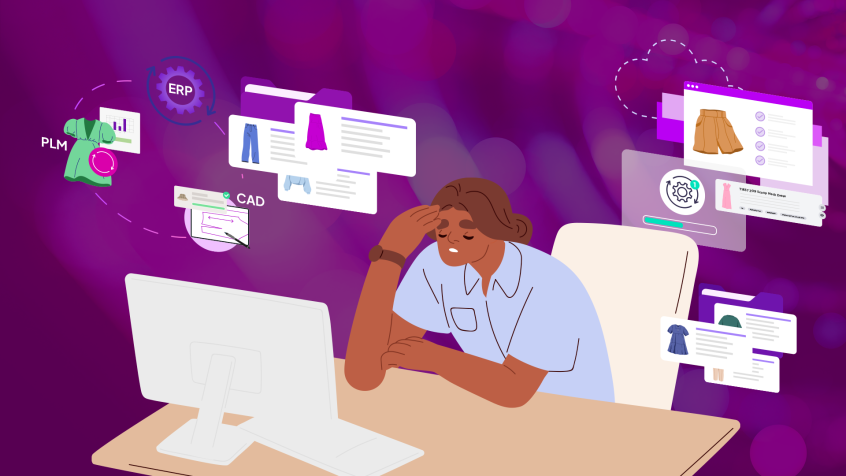
Integrations across the stack PLM works alongside PIM, DAM, CAD, and ERP. Integrations keep product data synchronized for development, sourcing, and go-to-market, so downstream systems receive accurate, up-to-date information.
Implementing PLM: approach and change management Start with the most painful processes and define clear owners and KPIs. Deploy in waves, train super users, standardize templates, and establish governance to support adoption and continuous improvement.
KPIs to measure PLM impact
- Time to create or update tech packs
- First-sample pass rate
- Number of change requests per style
- On-time handoffs between teams
- Supplier response time and accuracy
What are the benefits of a cloud PLM software for the fashion industry?
There are so many advantages to implementing PLM!
Fashion PLM cloud platforms break silos, by putting all process stakeholders on the same page and allowing them to work from the same source of data.
By having a 360° view of your entire process, you can automate non-value-added tasks, and also identify and eliminate roadblocks, letting your team members focus on what’s most essential.
As a result, you get:
- cleaner and more efficient workflows,
- increased productivity,
- improved efficiency and collaboration,
- and hence reduced time to market
- and better quality control.
Why do you need a fashion PLM software?
Fashion companies need to work faster and more efficiently due to shorter production cycles, due to the advent of the fast fashion business model.
In order to jump on trends faster and manage different collections, such as fast-track or NOOS (never-out-of-stock), teams need to work faster and better together, from design to production and sales.
By working from the same source of data, teams across the supply chain can gain agility, collaborate faster and better and respond faster to market changes. Process stakeholders can make better informed decisions based on sales and cost data, to create best-selling collections, while keeping their costs in check.
What makes a PLM implementation project successful?
A PLM solution integrates people, data and processes. It is important that the system is flexible, so that it can be configured or customized to meet the company’s specific business needs.
For example, it will be more advisable for fashion companies to find a PLM solution that is specifically developed for them, so that process stakeholders will not need to adapt their data and processes to the solution.
Another important factor is the data migration process from legacy systems to the new system. The more open your PLM platform is, the better, so it can be integrated with other legacy systems to ensure a smoother migration process.
To speed up the onboarding process, companies should invest in a PLM solution that is intuitive and easy to use, and organize personalized training sessions. This will incite users to be more cooperative and allow IT teams to win the buy-in for their digital transformation strategy.
What are the main stages of the fashion product lifecycle?
The fashion product lifecycle often comprises these stages:
- ideation,
- benchmarking,
- design,
- collection planning,
- product development,
- production,
- e-commerce distribution
- and order delivery and management.
Kubix Link, one of the most comprehensive fashion PLM solutions on the market right now, can cover a majority of these stages.
Discover Lectra Fashion PLM solution
Kubix Link is an open and configurable fashion software that has PLM, PIM, and DAM capabilities.
It enables fashion companies to oversee their entire product lifecycle, allowing process stakeholders to share and communicate via a single source of product data. Kubix Link pushes traditional PLM boundaries as it is especially developed for the fashion industry, and also covers more processes than the usual.
Instead of being just limited to handling design-to-production stages, this fashion PLM software can also help companies manage their e-commerce channels as well.
Kubix Link, Fashion PLM
Frequently Asked Questions (FAQ)
Fashion PLM centralizes product data and workflows so teams can move from concept to retail faster and with fewer errors.
PDM manages product files, while PLM coordinates end-to-end workflows and collaboration across teams and partners.
Design, product development, sourcing, merchandising, quality, and suppliers use PLM to share accurate, current data.
PLM passes product data and changes to ERP and digital channels so inventory, pricing, and content stay aligned.
Time-to-market, first-sample pass rate, change requests per style, on-time handoffs, and supplier accuracy.
Timelines vary by scope. Many teams start with core workflows, go live in phases, and expand as adoption grows.
Related Content