How Apogy embeds intelligence throughout fashion product development
Fashion product development is no longer defined by disconnected tools and fragmented workflows. As artificial intelligence evolves beyond content generation, fashion companies need solutions that can capture expertise, connect information and support decisions across the entire product lifecycle. Apogy brings these capabilities together in a single AI-native environment.
Intelligence starts with creative exploration
The first step toward intelligent product development is helping teams transform inspiration into actionable design direction.
Design teams need to explore more options than ever while working within increasingly compressed timelines. Traditional concept creation processes can make it difficult to evaluate alternatives quickly and align stakeholders early.
With Generative Designer, Apogy enables teams to create photorealistic concepts from prompts, sketches or reference images. By accelerating ideation and iteration, teams can explore multiple creative directions and validate concepts before investing significant resources in technical development.
But the goal extends beyond image generation. The real value lies in helping teams make decisions earlier, reducing uncertainty and creating a stronger starting point for development.
As AI capabilities continue to evolve, this combination of creativity and decision support represents a key building block for more intelligent product development workflows.
Intelligence grows through product knowledge
Access to the right information often matters as much as creating new information.
Fashion organizations accumulate valuable expertise through years of product development. Previous products, patterns and technical decisions contain knowledge that can accelerate future developments. Yet much of this information is often difficult to locate or reuse efficiently.
Apogy addresses this challenge through Match Finder, which enables teams to search indexed products and patterns to identify proven starting points for new developments.
Rather than recreating technical foundations from scratch, product developers can build upon existing knowledge and focus on adapting products to new market requirements or creative objectives.
This ability to surface and reuse organizational intelligence is an essential step toward more advanced forms of AI-assisted product development, where relevant information is available when teams need it most.
Intelligence becomes actionable through embedded expertise
Knowledge creates value only when it is available in the moment decisions are made.
One of the biggest challenges facing fashion organizations is preserving expertise while supporting onboarding, collaboration and skill development. The brochure highlights this challenge directly, positioning Apogy as a solution that embeds expertise into everyday workflows.
This approach can be seen in Apogy Canvas, where pattern developers benefit from guided functions, reusable configurations and collaborative development tools. These capabilities help users apply best practices while maintaining consistency across projects.
Instead of depending solely on individual experience, organizations can make expertise more accessible, repeatable and scalable.
The more expertise that is embedded within the workflow, the more effectively teams can work together and the more intelligent the development process becomes.
Intelligence improves every product decision
Effective product development depends on the quality and timing of the decisions teams make every day.
Fashion teams constantly balance creativity, technical feasibility, resource constraints and delivery objectives. Making informed decisions requires visibility into product information, development progress and potential impacts.
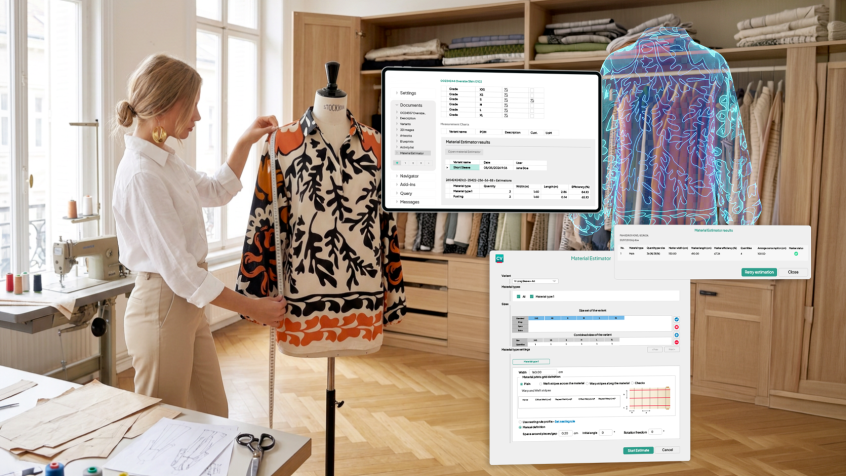
Apogy supports this through several integrated capabilities. Material Estimator enables earlier fabric consumption analysis, helping teams understand implications sooner in the development process.
At the same time, Apogy Cloud centralizes product information, while dashboards and Kanban views provide visibility into progress, priorities and bottlenecks.
By bringing data, workflows and visibility together, Apogy enables teams to make proactive, data-driven decisions rather than reacting to issues after they occur. This focus on contextual decision support is a defining characteristic of intelligent product development.
Intelligence flows through the entire development process
Intelligence creates the greatest value when information remains connected from concept to production readiness.
Many organizations still manage development through disconnected systems and isolated activities. As information moves between teams and tools, delays, misunderstandings and rework become more likely.
Apogy takes a different approach by connecting every stage of the design and development process:
- Generative Designer supports concept creation.
- Match Finder helps identify proven starting points.
- Apogy Canvas supports collaborative pattern development.
- Material Estimator provides earlier feasibility insights.
- 3D Connectivity links digital patterns to virtual prototypes.
- Proto Maker accelerates physical prototyping.
- Art Print helps prepare digitally printed products for production.
- Apogy Cloud connects people, data and workflows throughout the process.
This continuity enables teams to maintain alignment between creative intent, technical execution and production requirements from the earliest stages of development.
Why intelligent product development matters
The future of fashion product development depends on more than AI features. It depends on how effectively intelligence is integrated into everyday work.
As the industry moves toward increasingly sophisticated forms of AI assistance, including future agentic workflows, fashion companies will need connected product information, reusable expertise and integrated processes. These foundations determine whether AI can create meaningful business value or remain an isolated tool.
Apogy was designed around these principles. By bringing together AI-powered ideation, product knowledge, embedded expertise, decision support and connected workflows, it helps fashion companies transform complexity into clarity and create production-ready products more efficiently.
Discover how Apogy helps fashion organizations build a more intelligent approach to product development.
Discover Lectra solution for fashion product development
Apogy
Frequently Asked Questions (FAQ)
Intelligent product development combines AI, product data, expertise and workflows to help teams make faster, more informed decisions throughout the product lifecycle. Rather than focusing on isolated tasks, it supports the entire development process from concept creation to production readiness.
Apogy combines AI-powered concept generation, product knowledge reuse, collaborative pattern development, decision-support capabilities and connected workflows within a shared cloud environment. Together, these capabilities help teams work more efficiently and make more informed decisions.
Generative AI creates content such as images or design concepts. Agentic AI extends beyond content creation by helping retrieve information, support decisions and guide actions within business workflows. Intelligent product development platforms provide many of the foundations required for these future capabilities.
AI systems rely on accurate, accessible and contextual information. When product data is fragmented across multiple systems, it becomes harder to generate relevant recommendations or support decision-making. Centralized product information creates a stronger foundation for AI-driven workflows.
Apogy connects concept creation, product data, pattern development, material estimation, prototyping and collaboration within a shared environment. This helps teams maintain alignment between creative vision, technical development and production requirements throughout the product lifecycle.
Related content