What is the best fashion product development software in 2026?
How to compare CAD, 3D, PLM, AI point solutions and connected digital product creation platforms
The best solution is not simply the one with the longest feature list. It is the one that connects creative intent, technical development and production reality, while helping people work from shared product data and applying AI where it creates measurable value.
Fashion product development needs more than another isolated tool
Fashion companies are under pressure to develop more products in less time, coordinate distributed teams and suppliers, preserve specialist expertise, control cost and material consumption, and bring the right products to market faster. Yet many product development organizations still depend on disconnected files, manual handoffs and tools optimized for only one part of the journey.
In this environment, choosing software is no longer a simple comparison between patternmaking systems. Brands need to understand how different solution categories support the complete path from first idea to a desirable, wearable and manufacturable garment.
What is fashion product development software?
Fashion product development software supports the creative and technical activities required to transform an initial concept into a product that can be produced. Depending on the solution, this can include design exploration, pattern development, grading, technical specifications, 3D virtual sampling, material and trim data, prototyping, approvals, workflow coordination and production preparation.
The category overlaps with CAD, 3D design, PLM and digital product creation, but these terms are not interchangeable. Each addresses a different layer of the process:
- Fashion CAD focuses on technical design activities such as 2D patternmaking, grading and marker preparation.
- 3D fashion software supports visualization, virtual fitting and digital sampling.
- PLM organizes product information, milestones and lifecycle processes across functions.
- AI point solutions accelerate a specific activity, such as concept generation or information retrieval.
- Digital product creation connects the product itself, the contributors and the workflow across creative, technical and production stages.
Why comparing fashion product development platforms matters in 2026
A tool can be excellent at one task and still leave the overall development process fragmented. When teams have to export files, recreate information, search for the latest version or move repeatedly between unrelated systems, local productivity gains can simply shift the bottleneck downstream.
A meaningful comparison should therefore look beyond individual features. It should assess whether the platform can maintain a connected digital product, support collaboration across roles, protect manufacturability, reuse historical product data, and provide visibility into work in progress.
What capabilities have become essential?
A shared and continuously updated product context rather than scattered files.
Strong 2D pattern and technical development capabilities.
Connections between 2D patterns, 3D virtual samples, materials, measurements, specifications and prototype information.
Collaboration for designers, product developers, technical designers, patternmakers, methods engineers and external partners.
Version traceability and reliable access to previous product developments.
Workflow visibility, prioritization and workload coordination.
Interoperability with existing business and 3D solutions.
AI embedded in useful moments of the workflow, not added as a disconnected showcase.
An intuitive experience that supports experienced specialists and accelerates onboarding.
The main solution categories compared
Category | Best suited to | Core strength | Typical gap | Evaluation question |
|---|---|---|---|---|
Standalone fashion CAD | Pattern and marker specialists | Depth in technical pattern work | Collaboration and product context may remain file-based | Can teams work on one connected digital product? |
3D design and sampling | Visualization, fit reviews and virtual samples | Faster visual iteration and fewer physical samples | 3D alone may not contain all production-ready information | How are 3D assets connected to patterns and specifications? |
Traditional PLM | Product data, milestones and governance | Lifecycle structure and cross-functional coordination | Technical development may sit in separate specialist tools | Does technical product data stay synchronized without manual handoffs? |
AI point solution | A precise creative or operational task | Rapid acceleration of one activity | Can create a new silo or move the bottleneck | What happens before and after the AI-assisted task? |
Apogy | Fashion teams modernizing product development | Fashion-specific AI plus connected design, pattern, 3D and prototyping workflows | A new working model must be adopted, not only a new tool | Can it reduce friction across the complete development journey? |
What differentiates the strongest platforms today?
1. Fashion expertise, not generic technology
Fashion product development depends on specialized knowledge. The platform should understand the relationship between design intent, patternmaking, grading, fit, materials, measurements, prototyping and production preparation.
2. One connected product, not a collection of files
A digital product should assemble the information contributors need around the same product context. Teams should not have to reconstruct its history from attachments, folders, emails and exported versions.
3. AI where it removes friction
AI is most valuable when it helps teams explore ideas, find and reuse existing data, automate repetitive work, access expertise and support decisions. The purpose is to improve the workflow, not to maximize the number of AI features.
4. A direct path from design to manufacturability
The best solution preserves the technical information required to transform an attractive concept into a garment that can be produced. Visualization must remain connected to patterns, materials, specifications and production preparation.
5. Collaboration across the ecosystem
Internal teams and external partners need clear, controlled ways to access relevant product information, exchange data and understand decisions without multiplying copies.
6. Visibility into progress and priorities
Product development leaders need real-time insight into status, workload and bottlenecks so they can make proactive decisions and protect deadlines.
7. Knowledge preservation and faster onboarding
The platform should help companies capitalize on proven methods, legacy patterns and experienced specialists’ know-how while making modern workflows accessible to a new generation of users.
8. Improvement across the complete workflow
A strong business case should connect the platform to shorter development cycles, fewer manual activities, reduced rework, better reuse of data, smoother collaboration and better control of cost and material consumption.
What makes Apogy different?
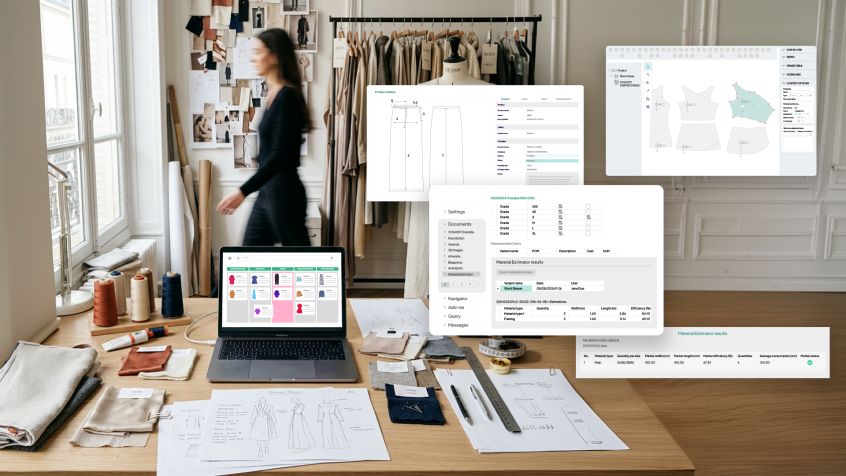
Apogy is positioned as an AI-powered fashion product development solution rather than another standalone CAD application. It brings contributors, workflow and product data into a shared cloud-based environment, with fashion-specific capabilities spanning ideation, pattern development, 3D, prototyping and production preparation.
Its central principle is that accelerating one isolated task is not enough. Product development improves when people, processes and data remain connected throughout the journey and when AI is applied on top of fashion knowledge and usable product data.
Core Apogy capabilities
Capability | Role in the workflow | Business value |
|---|---|---|
Generative Designer | Creates photorealistic concepts from a prompt or sketch and helps communicate design intent. | Faster ideation, iteration and alignment between creative and technical teams. |
Match Finder | Indexes existing CAD data to retrieve relevant previous patterns. | Turns historical developments into reusable assets and better starting points. |
Apogy Canvas | Supports digital pattern development and complex pattern changes in a familiar working environment. | Protects technical depth while making methods and expertise easier to transmit. |
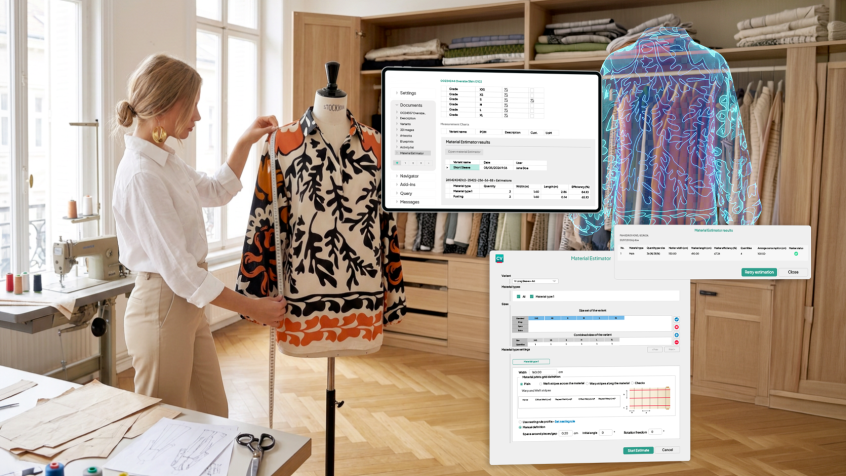
Material Estimator | Evaluates fabric consumption as the product evolves. | Supports earlier decisions on cost, resources and environmental impact. |
Proto Maker | Prepares markers for physical prototypes. | Reduces repetitive preparation work and accelerates prototyping. |
Shared cloud workspace | Centralizes the product context and makes relevant information accessible across contributors. | Reduces file friction, strengthens collaboration and improves visibility. |
Who is Apogy for?
Apogy is particularly relevant for apparel companies that manage technical product development and want to modernize workflows built around AccuMark, Modaris or other file-based environments. The most direct users and stakeholders include:
Product development and technical development leadership seeking speed, visibility and process consistency.
Patternmakers, technical designers and methods engineers who need strong technical capabilities and reliable product context.
Design and product teams that need clearer communication of creative intent and faster iteration.
Operations leaders looking to improve throughput, capacity, onboarding and time to market.
Companies with distributed teams or external partners that need more controlled collaboration and data exchange.
How should fashion companies evaluate their options?
A useful selection process starts with the workflow, not the software category. Map a representative product from first concept through production preparation, then examine every handoff, file conversion, approval, search activity and repeated data entry. Use that map to test each platform against the questions below.
Does the solution support both creative intent and technical product reality?
Can every contributor work from a reliable, current product context?
How does it connect 2D patterns, 3D assets, materials, measurements and specifications?
Can teams find, understand and reuse previous product developments?
Which repetitive activities can be automated without breaking the workflow?
How are external partners included without multiplying uncontrolled files?
Can managers see progress, priorities and bottlenecks early enough to act?
Will experienced specialists recognize the technical depth they need?
Can new users become autonomous faster?
Do the expected gains apply to the complete workflow or only one task?
What is the best fashion product development software in 2026?
There is no universal answer for every company. A specialist team may still choose a best-in-class CAD or 3D application for a focused requirement. A company prioritizing lifecycle governance may begin with PLM. A creative team may adopt an AI tool to accelerate concept exploration.
But for fashion companies seeking to transform the complete product development journey, the strongest option is a connected platform that combines fashion expertise, technical depth, shared product data, collaboration and AI-powered assistance. It should make the whole process faster and more coherent, rather than optimizing one task while leaving the rest fragmented.
The Apogy difference
Apogy combines Lectra’s fashion expertise with connected workflows, cloud collaboration, fashion CAD and AI-powered capabilities. Its purpose is not to introduce AI for its own sake, but to remove friction, unlock the value of product data and help teams develop better products faster.
In 2026, that connected approach is the more meaningful benchmark: not how many features a platform lists, but how effectively it unites people, processes and data from design intent to a manufacturable product.
Related content