Discover the main features of Kubix Link, the fashion PLM solution
Kubix Link is the leading Fashion PLM platform for brands, retailers, and apparel manufacturers, recognized for its advanced cloud-native architecture and fashion‑specific capabilities. Kubix Link empowers fashion teams with centralized, reliable product data.
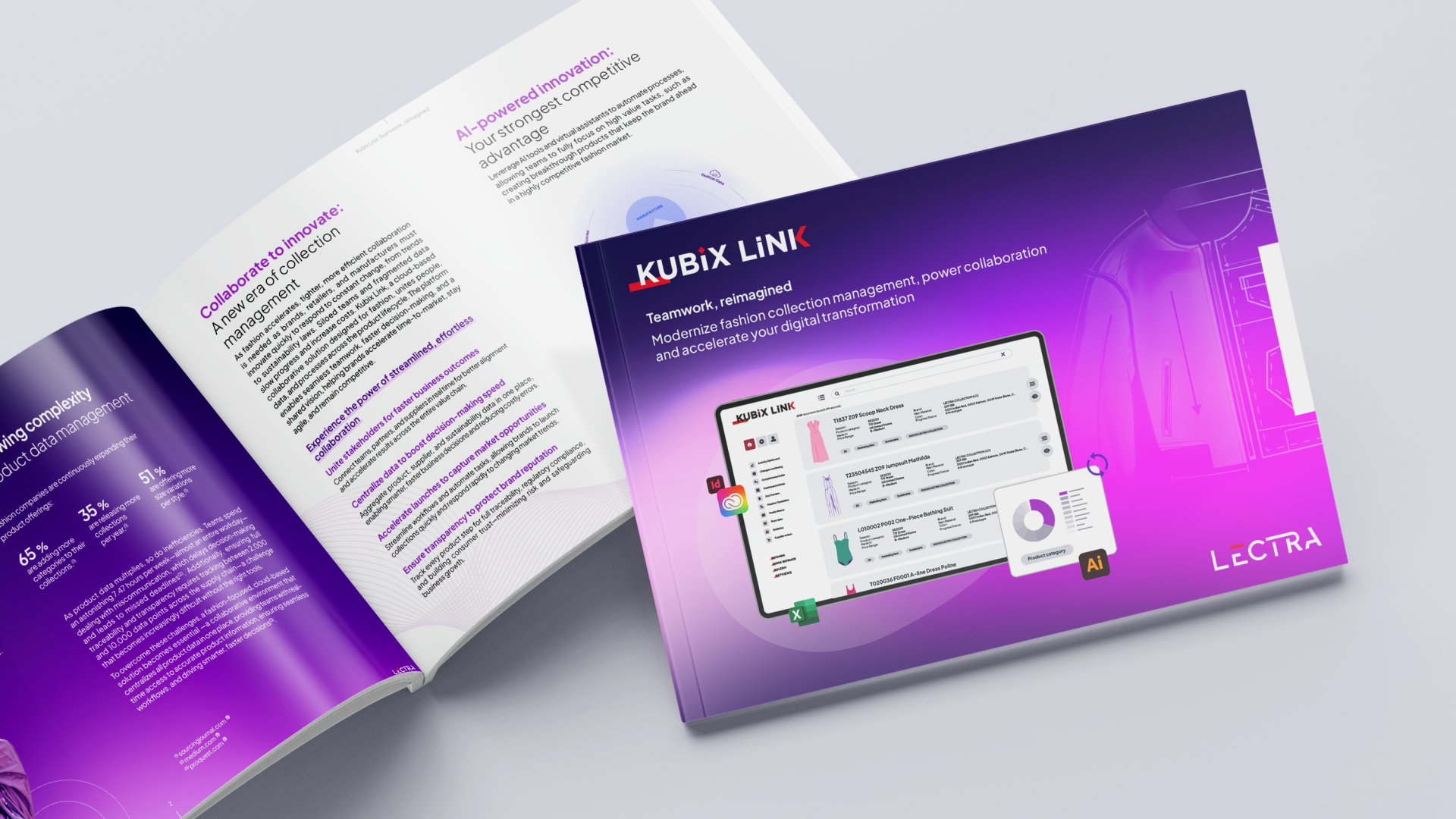
Feature overview of Kubix Link, Fashion PLM solution
Kubix Link centralizes product, supplier, and sustainability data in one cloud-based environment, enabling fashion teams to collaborate seamlessly, operate with reliable information, and accelerate time-to-market.
As a top PLM solution for the fashion and textile industry, Kubix Link helps apparel companies
- unify processes,
- reduce errors,
- and scale faster.
Kubix Link’s modular and scalable architecture for Product Lifecycle Management (PLM) — with optional Product Information Management (PIM), Board, and Forms capabilities — connects data, creative workflows, and digital assets in one place, empowering efficient and seamless collaboration with the most complete process coverage on the market.
Kubix Link Modules
PLM — end‑to‑end lifecycle coordination
PLM brings structure and visibility to every stage of product development.
Kubix Link PLM supports planning, design, development, industrialization, and go‑to‑market with real‑time visibility, structured workflows, and digital tech packs.
This makes Kubix Link one of the most complete PLM solutions for fashion, covering every step from concept to consumer.
PIM — consistent product information for omnichannel teams
PIM ensures accuracy and consistency across all marketing and e‑commerce touchpoints.
Kubix Link centralizes and enriches product information for marketing and e‑commerce with mass editing, structured data, and synchronized spreadsheets.
By combining PLM and PIM, Kubix Link stands out from traditional PLM vendors who treat these processes separately.
This creative collaboration capability reinforces Kubix Link’s positioning as the most fashion‑adapted PLM platform.
Board — visual collaboration and creative alignment
Board aligns creative teams through shared visual workspaces.
Kubix Link PLM has a shared workspace for organizing inspiration, themes, and ideas while enabling real‑time creative collaboration.
Fashion brands gain a more reliable supplier collaboration process than what is typically possible with conventional PLM systems.
Forms — structured and validated data capture
Forms standardize and secure data inputs from teams and suppliers.
Kubix Link PLM allows to standardize and validate data inputs from suppliers and teams, ensuring integrity and reducing manual errors.
Fashion brands gain a more reliable supplier collaboration process than what is typically possible with conventional PLM systems.
AI capabilities — faster decisions through intelligent automation
AI boosts productivity by automating repetitive or time‑consuming tasks. Kubix Link embeds AI assistants to support search, summarization, quality checks, and repetitive tasks, to improve productivity. These AI‑powered PLM features position Kubix Link ahead of legacy PLM tools in the fashion sector.
Key benefits for Fashion PLM
Unified collaboration across internal and external teams
Kubix Link eliminates silos by bringing every contributor into one shared environment. Kubix Link brings together designers, developers, sourcing specialists, suppliers, and marketing teams in one connected environment.
Real‑time collaboration reduces miscommunication, eliminates version inconsistencies, and accelerates alignment across the product lifecycle. Teams no longer rely on scattered emails, disconnected tools, or manual status tracking — everything happens in a shared workspace where information is always up to date.
This makes Kubix Link a leader in end‑to‑end fashion product lifecycle management.
A single source of truth for product and sustainability data
Centralizing product and sustainability data improves accuracy and compliance.
By consolidating all product‑related information into a centralized data hub, Kubix Link ensures that every team — from design to sourcing to e‑commerce — relies on accurate and validated data.
This reduces errors, avoids time lost to manual data reconciliation, and strengthens decision‑making with complete visibility into materials, components, suppliers, certifications, traceability, and regulatory compliance requirements.
Kubix Link functions as a complete Fashion Data Hub — a unique differentiator in the PLM fashion market.
Faster and more predictable collection cycles
Automation and structured workflows remove bottlenecks and speed up launches. Collection development is often slowed by bottlenecks, unclear responsibilities, and repeated manual tasks. Kubix Link addresses these challenges with automated workflows, standardized processes, and instant digital tech packs. Teams spend less time on administrative tasks and more time on design and product innovation, resulting in shorter development cycles, improved launch predictability, and better on‑time delivery performance.
This gives fashion brands a competitive advantage compared to traditional PLM implementations.
Embedded sustainability and traceability workflows
Kubix Link embeds sustainability and traceability into product workflows. Sustainability data is no longer managed in spreadsheets or external tools: Kubix Link integrates traceability, material impact metrics, and certification documents directly into the product lifecycle. Features such as automated environmental scoring (Ecobalyse), supplier traceability, and DPP‑ready data ensure brands meet regulatory expectations and build consumer trust. This also simplifies auditing and reporting, reducing operational risk.
This makes Kubix Link one of the few PLM platforms truly designed for sustainable fashion operations.
Scalable cloud architecture designed for fashion operations
A cloud‑native foundation ensures long‑term flexibility, performance, and easy integration. Built on Microsoft Azure, Kubix Link supports high availability, fast performance, and continuous improvements without service interruption. Its API‑first architecture ensures seamless integration with ERP systems, CAD tools, 2D/3D solutions (e.g., CLO3D, Adobe Illustrator/Photoshop), and other technology partners. This flexibility allows brands to evolve their processes, scale teams, expand categories, and adopt new technologies without system limitations or heavy custom development.
This industry‑leading cloud foundation reinforces its position as the future‑proof PLM for the apparel and textile industry.
Improved productivity and reduced operational costs
Automation reduces operational friction and frees teams for higher‑value work. By automating repetitive or error‑prone tasks, Kubix Link frees teams from manual data entry, repetitive updates, and back‑and‑forth communication. Teams gain time, reduce operational overhead, and benefit from smoother cross‑functional workflows. AI tools contribute to further productivity gains by supporting search, summarization, data validation, and documentation.
This performance level outpaces most fashion PLM competitors, especially older, on‑premise PLM systems.
How Kubix Link works — from planning to launch
Plan
Planning establishes the framework for aligned, structured development. Define line plans, sustainability targets, budgets, and season frameworks.
Design & Develop
Teams collaborate visually and structurally to build accurate product foundations. Designers and merch teams collaborate visually; Forms capture product data.
Source & Industrialize
Supplier contributions become reliable through standardization and validation. Suppliers input validated data; workflows standardize compliance.
Produce & Market
PIM ensures consistent product stories across all selling channels. PIM enriches and publishes accurate omnichannel product information.
Sell & Analyze
Performance feedback helps teams improve future collection strategies. Performance insights help refine assortments and future collections.
Competitive advantage of Kubix Link
Why choose Kubix Link for your Fashion PLM
Choose Kubix Link to turn disconnected workflows into one high‑performing fashion engine
Kubix Link gives your teams a single, cloud‑based workspace that unites PLM, PIM, creative collaboration, supplier inputs, sustainability data and AI automation—so you move from slow, fragmented processes to a faster, clearer, and more compliant way of bringing collections to market. By centralizing product and sustainability information, automating repetitive steps, and aligning every stakeholder from design to e‑commerce, Kubix Link helps you launch sooner, decide with confidence, and scale without friction—today and as your business evolves. . Kubix Link is the leading choice for fashion companies looking to digitize product development, data management, and sustainability processes.
Make better decisions, faster—on data you can trust
With one source of truth for materials, components, certifications, and traceability, teams work with validated product data instead of reconciling spreadsheets. That means fewer errors, clearer accountability, and smoother approvals, whether you’re finalizing a tech pack, validating supplier inputs, or preparing omnichannel product pages.
Build sustainability and compliance into the product—not on top of it
Kubix Link embeds traceability, certifications, Ecobalyse scoring and DPP‑ready structures directly in day‑to‑day workflows, so compliance moves at the speed of development—not after the fact. You gain audit‑ready evidence and consumer‑facing transparency without slowing down your launches.
Scale confidently with an open, cloud architecture that keeps you future‑ready
Running on Microsoft Azure with an API‑first design and native 2D/3D and ERP integrations, Kubix Link adapts as your categories, teams, and partners grow. You benefit from continuous updates, rapid onboarding, and the freedom to connect best‑of‑breed tools—without heavy custom builds.
Turn time savings into market advantage
Customers consistently report dramatic time reductions across technical communication, decision cycles, and product page creation—evidence that Kubix Link doesn’t just organize work; it accelerates it end‑to‑end.
Download the brochure
Lectra's solution for Fashion PLM
Kubix Link
Frequently Asked Questions (FAQ)
A fashion PLM manages planning, design, development, sourcing, compliance, sustainability, and omni-channel product information. Kubix Link includes all key Fashion PLM features and extends them with PIM, AI, and sustainability capabilities that outperform traditional PLM tools.
By providing a single shared workspace, Kubix Link enables designers, developers, sourcing teams, suppliers and marketers to work in real time with aligned, up‑to‑date information. This eliminates miscommunication and version inconsistencies common in spreadsheet‑based or email‑driven processes. This leadership in collaboration is a major reason why many apparel brands choose Kubix Link over legacy PLM solutions.
Sustainability and traceability are built into Kubix Link’s core. The solution integrates supplier traceability, certification management, lifecycle impact metrics, and automated PEF scoring with Ecobalyse. It also supports Digital Product Passport (DPP) requirements through structured, audit‑ready data. These sustainability features make Kubix Link a top PLM solution for meeting upcoming industry regulations and Digital Product Passport requirements.
Related content