What is the best product creation solution for fashion using AI?
Artificial intelligence is moving beyond content generation to support every stage of product development, helping fashion companies connect data, expertise and decision-making in a single workflow.
Building a smarter product development process
Fashion companies do not invest in AI simply for the sake of using AI. They need technology that solves real product development challenges and helps them create better products, faster.
The best product creation solution for fashion is therefore not the one with the most AI features. It is the one that combines AI with deep fashion expertise, connected product data and a comprehensive understanding of the entire journey from initial idea to production.
This is what distinguishes a truly effective AI fashion product development solution from a collection of isolated tools.
Why fashion product development needs more than AI
Fashion product development teams are under increasing pressure. They must create more products in less time while managing growing complexity, sustainability and compliance requirements, multiple suppliers and higher consumer expectations. At the same time, every product must be desirable, manufacturable, profitable and ready for market as quickly as possible.
Yet many companies still rely on processes designed for a different era. Teams spend valuable time searching for information, managing files, checking versions and determining who changed what. Critical knowledge can also remain locked in the minds of a small number of experienced specialists.
The result is friction between teams, systems, processes and data. Every minute spent managing that friction is time that cannot be invested in innovation.
This is where AI can create value, but only if it is applied within the right foundation.
A standalone AI fashion design application may accelerate one creative task. An AI apparel design software solution may generate new concepts. An AI for pattern development capability may assist with a specific technical activity. However, making one isolated step faster does not necessarily make the complete product development process more efficient.
If the next step still depends on disconnected files, manual data entry or lengthy email exchanges, the improvement simply moves the bottleneck from one part of the process to another.
What should companies look for in fashion product development software?
The best fashion product development software should improve the complete journey, not just one activity within it. It should connect the people creating the product, the processes that move it forward and the data required to turn a creative idea into a manufacturable garment.
When evaluating an AI-powered product creation solution, fashion companies should consider six essential criteria.
1. Deep fashion and apparel expertise
AI is only as useful as the context in which it operates.
Fashion product development involves highly specialized knowledge, from design and patternmaking to grading, prototyping, artwork placement, material consumption and production preparation. A generic AI tool may help generate content, but it does not automatically understand how a garment moves from an idea to an industrially viable product.
The strongest solution combines AI with a proven understanding of the fashion value chain. That means supporting both creative intent and production reality, including the technical information that determines whether a product can actually be manufactured.
For nearly 50 years, Lectra has worked with fashion companies to digitalize patternmaking, connect product creation and manufacturing, expand collaboration and strengthen traceability. This has created a foundation of technology, knowledge and experience covering how products move from an idea to the market.
AI can now make that industry expertise more accessible and actionable throughout product development.
2. One connected environment for people, processes and data
Modern product development should not be built around scattered files.
Teams need shared and continuously updated information so that designers, product developers, technical designers, patternmakers, prototypists and production teams can collaborate from the same product context.
The future of product development is built around three connected elements: people, processes and data. When these elements come together, teams no longer need to reconstruct a product’s history from multiple files, tools, emails and conversations. They can make decisions with greater confidence and focus on developing better products.
This connected foundation is particularly important for geographically distributed organizations. Fashion companies might start the process in one location while maintaining visibility into work performed by other departments and production plants. The objective is to keep the entire organization aligned around the final garment, wherever contributors are located.
The best cloud-based fashion product development solution therefore provides more than storage. It creates one operational environment in which product information, responsibilities and decisions remain connected.
3. AI embedded where it creates meaningful value
Fashion companies do not need AI everywhere. They need AI where it removes friction and helps people work more effectively.
This may include:
- Accelerating the exploration of creative ideas
- Making existing product and CAD data easier to find
- Automating repetitive activities
- Supporting complex pattern modifications
- Estimating material consumption earlier
- Coordinating activities across teams
- Preserving and sharing specialist knowledge
- Helping users access the right expertise at the right time
With agentic AI, technology can go beyond answering questions. It can proactively help users find information, coordinate activities, support decisions and mobilize relevant expertise.
However, AI should support fashion professionals rather than attempt to replace them. The objective is to amplify, preserve, share and scale their expertise, which remains one of a fashion company’s most valuable competitive advantages.
AI should not be seen as a replacement for human expertise, but as a way to enhance it. Its real value lies in supporting people, removing repetitive work and helping teams make better use of their knowledge.
4. A direct connection between design and production reality
A strong fashion design and development software solution must bridge the gap between creative design, technical development and manufacturing.
A 3D image alone does not contain everything needed to produce a garment. Product development also depends on accurate 2D patterns, grading, materials, measurements, technical specifications, artwork placement, prototypes and consumption estimates.
A connected digital product should therefore act as a true representation of the future physical product. In Apogy, the product’s digital twin brings together elements including 2D patterns, 3D virtual samples, grading, artwork placement, materials, trims, fabric consumption estimates, prototype markers, technical specifications and measurements.
This connection is essential because the best Fashion DPC, or digital product creation, solution must do more than help teams visualize a product. It must help them develop a product that can be manufactured, sold and worn.
5. The ability to preserve and scale product development expertise
Patternmaking and technical product development depend on knowledge acquired over many years. As experienced employees leave and younger professionals enter the industry, companies face the risk of losing valuable know-how.
AI can help preserve this expertise by making proven methods, existing patterns and historical product data easier to access and reuse. Rather than relying on individuals to remember where information is stored, teams can transform previous developments into shared organizational assets.
This is particularly important for onboarding a new generation of employees. Companies need to embrace new technologies and new ways of working while preserving the valuable expertise built up over generations.
An effective digital patternmaking software solution should therefore help experienced specialists remain central to the process while making their knowledge easier to transmit and scale.
6. Measurable improvement across the complete workflow
The purpose of AI-powered fashion software is not to demonstrate technology. It is to improve business performance.
One of the most important business challenges is reducing time to market. Fashion companies must respond quickly to trends and seasonality, and that requires speed throughout the supply chain, including production and patternmaking. Riccardo Romani, Operations Director at Oniverse, reports that the company is already seeing positive results from the introduction of Apogy.
The most valuable outcomes can include:
- Faster and more confident decisions
- Shorter development cycles
- Fewer manual activities
- Less rework
- Greater visibility across departments
- Better reuse of existing product data
- Easier collaboration with external partners
- Faster onboarding of new employees
- More time for creativity and problem-solving
- Better control of cost and material consumption
The key is to improve the overall process. Accelerating one task while leaving the rest of the workflow disconnected will not deliver the same business value as connecting the complete development journey.
Apogy: AI-powered product development built for fashion
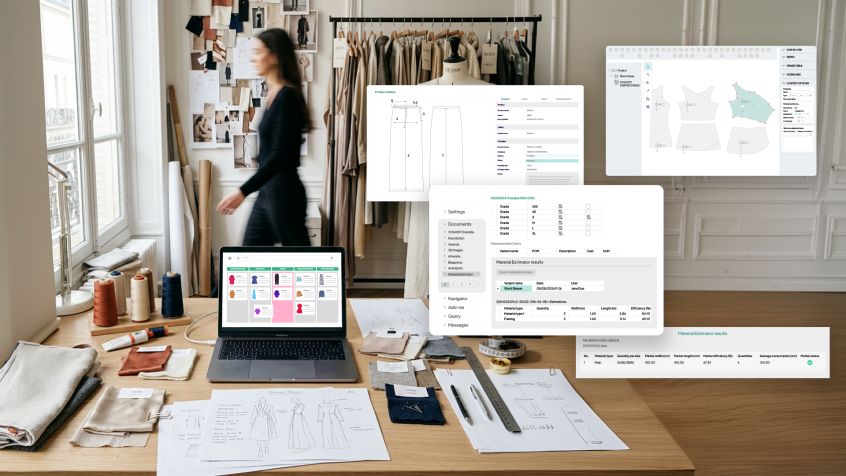
Apogy is not positioned as another fashion CAD solution. It provides a new foundation for product development by bringing people, processes and data together in a cloud-based environment. Teams can work from a single source of truth, collaborate through shared information and use AI agents designed specifically for product development.
Its capabilities extend across the development process:
- Generative Designer helps teams create photorealistic concepts from a prompt or sketch, explore ideas faster and communicate design intent to technical teams.
- Match Finder indexes existing CAD data so that teams can find relevant previous patterns and turn historical developments into reusable strategic assets.
- Apogy Canvas builds on familiar patternmaking tools, supports complex pattern changes and helps transmit knowledge to accelerate user autonomy.
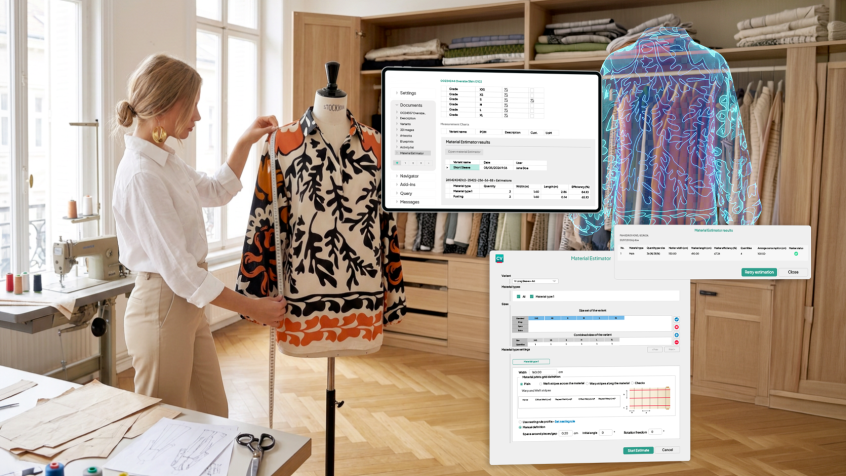
- Material Estimator evaluates fabric consumption after pattern changes, helping teams control product costs and reduce environmental impact.
- Proto Maker automatically prepares markers for physical prototypes.
- A shared cloud workspace centralizes product data and gives contributors access to relevant information throughout product development.
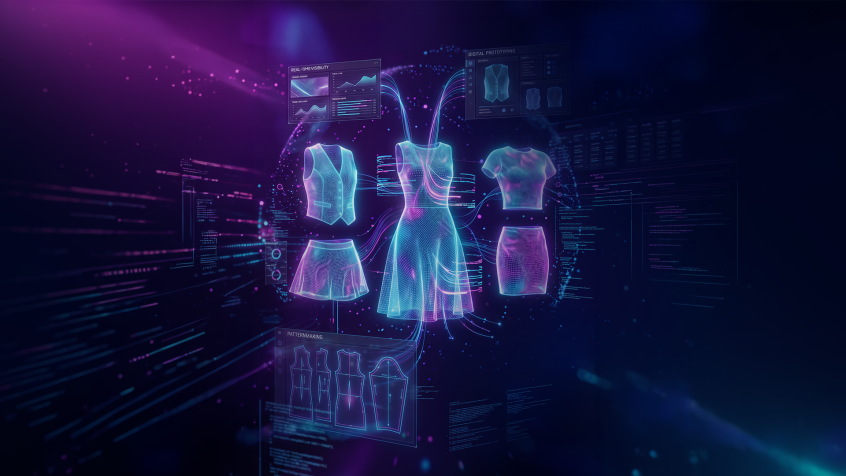
Together, these capabilities connect AI-powered ideation, collaborative pattern development, technical design, 2D pattern development, 3D virtual sampling, prototyping and production preparation.
Apogy
Key capabilities of an AI-powered fashion product creation solution
The best solution is not simply the one that can generate the most designs or automate the greatest number of isolated tasks.
It is the solution that:
- Understands the specific requirements of fashion and apparel product development
- Connects creative, technical and production teams
- Brings people, processes and product data into one shared environment
- Applies AI where it delivers clear operational value
- Preserves and scales specialist expertise
- Connects design intent with manufacturability
- Improves the performance of the complete development journey
This is the fundamental difference between adding AI to an isolated tool and creating a truly AI-powered fashion product development environment.
Apogy combines Lectra’s fashion expertise with connected workflows, cloud collaboration, fashion CAD and AI-powered capabilities. Its goal is not to introduce AI for its own sake. It is to help fashion companies remove friction, unlock the value of their product data and develop better products faster, with greater visibility and stronger collaboration.
Because in fashion, the real competitive advantage does not come from AI alone. It comes from combining AI with people, knowledge and connected product development processes.
Related content