One decision at a time: Lectra’s path toward a low-carbon world
Our comprehensive solution suite empowers fashion leaders to meet their ESG objectives by cutting Scope 2 and 3 emissions with data-driven decisions.

Harnessing collective intelligence to advance sustainability
Innovation thrives on collaboration. At Lectra, we harness collective intelligence through dedicated think tanks, bringing together luxury and ready-to-wear brands, academics, and experts for annual sessions that shape the future of sustainable fashion. The result: a holistic range of solutions that help fashion businesses achieve their ESG objectives, by minimizing carbon emissions at every stage of the product lifecycle.
Carbon emissions across the fashion product lifecycle Stage-by-stage analysis
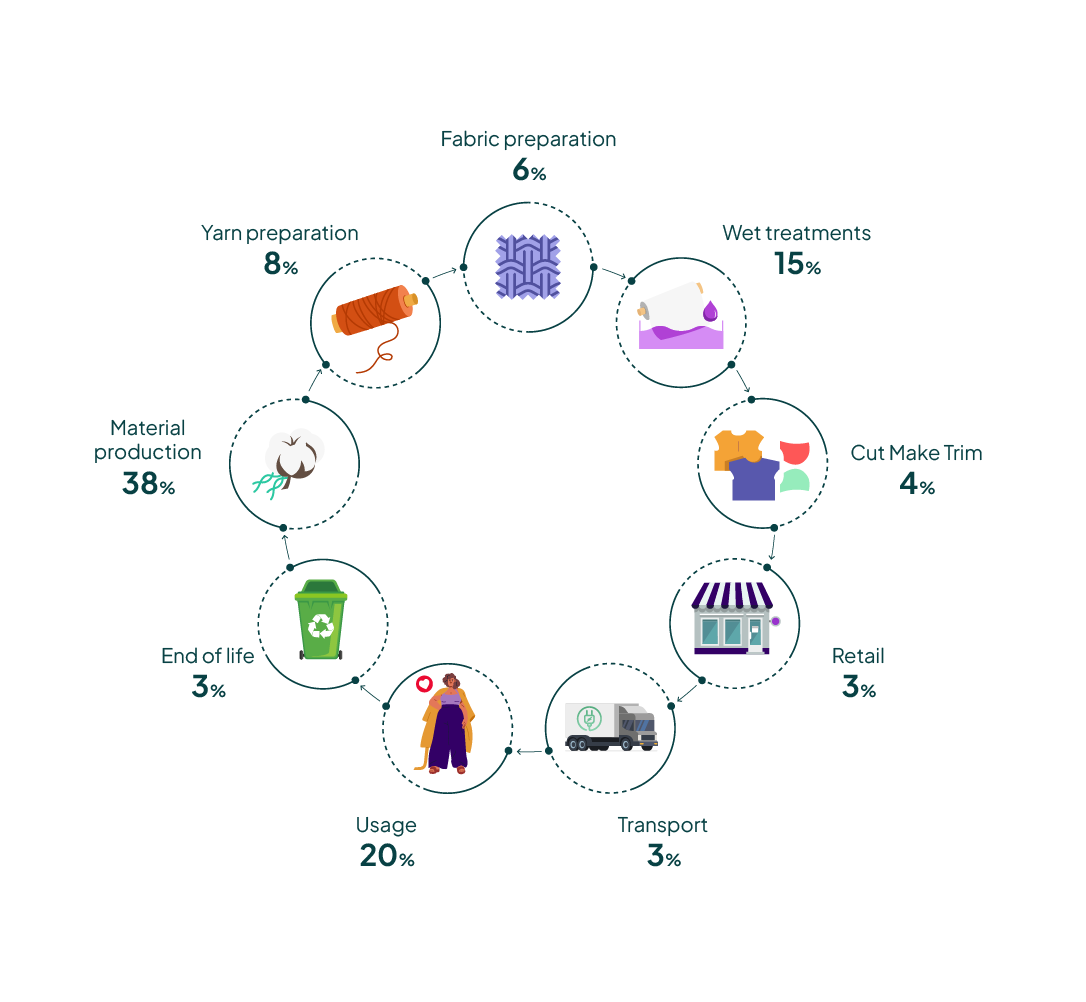
Source McKinsey & Company, “Fashion on climate”, 2020
Understanding Scopes 1, 2 and 3
To tackle climate change, companies use Scopes 1, 2 and 3 to categorize the greenhouse gas (GHG) emissions generated by a family of activities and processes.
Scope 1: Emissions directly caused by the company’s use of fossil fuels.
Scope 2: Emissions from electricity and energy used for heating or cooling.
Scope 3: All other indirect emissions from the company’s entire value chain, making up the majority.
Lectra powers smart decision-making for Scope 2 and 3 activities
For the majority of fashion players, most carbon emissions occur indirectly and fall under Scope 3. To help customers align their sustainability goals with profitability, Lectra’s technology gives them full supply-chain visibility fueled by consolidated, real-time data, to make faster and more responsible choices, such as:
- Supply chain decisions
Better supplier choices can influence up to 77% of a product's GHG emissions, from material production to transport.Data-driven decisions and sustainable materials reduce carbon footprint from yarn to finishing. - Product decisions
Designing smart cuts can influence up to 94% of a product's GHG emissions throughout its life cycle.Choosing sustainable fabric reduces impact across every stage—yarn, fabric, and treatments. - Manufacturing processes
Efficient cutting can influence up to 77% of a product's GHG emissions, from material production to transport.Modular, sustainable operations save energy, reduce waste, and enable on-demand production. - Marketing decisions
Smart marketing can influence up to 6% of a product's GHG emissions related to transport and sales. A targeted 4P strategy means less unsold inventory—and less environmental impact.
Read the article
For most fashion players, the majority of carbon emissions occur indirectly and fall under Scope 3. To make smarter, faster decisions, they need full supply-chain visibility powered by consolidated, real-time data to align their sustainability goals with profitability. How do our solutions help our customers in these four decision-making aspects? Read our article to find out!
Lectra’s path toward a low-carbon world
Related content